CAC – INDIVIDUAL ARTIST FELLOWSHIPS
INDIVIDUAL ARTIST FELLOWSHIPS (AIF): Region 3 – The Bay Area – Administered by Kala Art Institute
Presented in partnership with the California Arts Council, celebrating 50 years of investing in California’s artists.
Application Opens: April 2, 2026
Deadline: June 5, 2026
Grant Awards: $5,000 – $50,000
Grant Activity Period: September 1, 2026 – August 31, 2027
Download Program Guidelines PDF
Info Session: Thursday, April 16, noon
Zoom link: https://us02web.zoom.us/j/87862879755
Info Session: May 6, noon
Zoom link: https://us02web.zoom.us/j/87656828820
Office Hours: CAC Individual Artists Fellowship
Drop by the Kala Gallery, 2990 San Pablo Ave., Berkeley or give us a ring with application questions
Wednesday, April 22⋅11am-1pm
Tressa – tressa@kala.org
510-841-7000 x204
April 29 (Mayumi), 11am-1pm
Mayumi – mayumi@kala.org
510-841-7000 x201
May 20, 11am-1pm
Ellen – ellen@kala.org
510-520-6438
Staff Contact:
Mayumi Hamanaka, Kala Co-Executive Director, mayumi@kala.org
Tressa Jones, Kala Communications & Development Manager, tressa@kala.org
Ellen Lake, Kala Co-Executive Director, ellen@kala.org
Program Guidelines: Table of Contents
1. Program Overview and Purpose
2. About Kala Art Institute
3. Eligibility
4. Fellowship Tiers + Award Amounts
5. Accessibility + Accommodations
6. Timeline
7. Grantee Requirements/Expectations
8. Application Requirements + Evaluation Criteria
9. Panel Review Process + Scoring Rubric
10. Application Questions
11. Questions and Contact Info
1. Program Overview and Purpose
Through regionally based Administering Organizations (AOs), the Individual Artists Fellowship (IAF) program uplifts and celebrates California artists across all disciplines and traditions, highlights their excellence and acknowledges their leadership in shaping traditional and contemporary cultures.
For this opportunity, excellence is defined by:
– A unique artistic vision
– A sustained commitment to creative practice
– Engagement with and impact on the cultural ecosystem
The CAC has selected Kala Art Institute to design and implement a fellowship program that supports individual artists and culture bearers across all disciplines in the Bay Area. This initiative is dedicated to ensuring equitable access to resources by reaching artists in all 58 counties. By providing unrestricted funding, the fellowship empowers artists at pivotal moments in their careers, enhancing their ability to contribute meaningfully to California’s diverse communities. Investing in individual artists and culture bearers through this program strengthens artistic expression, creative practice, and community collaboration statewide.
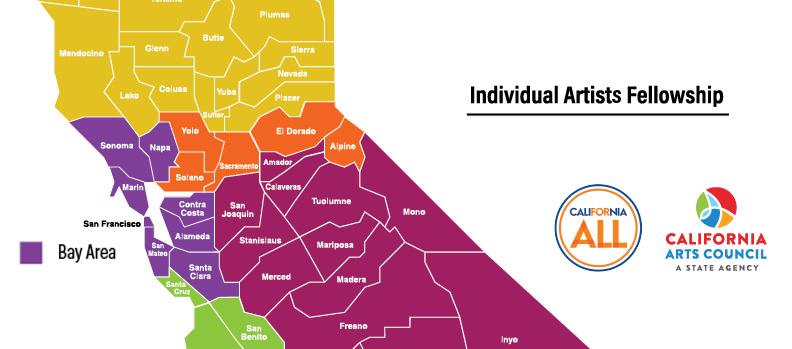
The Individual Artist Fellowships program for the Bay Area (Region 3) serves artists residing in the following counties:
Alameda County, Contra Costa County, Marin County, Napa County, San Francisco County, San Mateo County, Santa Clara County, Sonoma County
If you do not reside in one of the above counties, but are a resident of California, please apply through the appropriate regional Administering Organization below:
Region 1: Upstate
Nevada Arts Council, serving Butte, Colusa, Del Norte, Glenn, Humboldt, Lake, Lassen, Mendocino, Modoc, Nevada, Placer, Plumas, Shasta, Sierra, Siskiyou, Sutter, Tehama, Trinity, and Yuba Counties
Region 2: Capital
Teatro Nagual, serving Alpine, El Dorado, Sacramento, Solano, and Yolo Counties
Region 3: Bay Area
Kala Art Institute, serving Alameda, Contra Costa, Marin, Napa, San Francisco, San Mateo, Santa Clara, and Sonoma Counties
Region 4: Central Valley & Eastern Sierra
Kern Dance Alliance serving Amador, Calaveras, Fresno, Inyo, Kern, Kings, Madera, Mariposa, Merced, Mono, San Joaquin, Stanislaus, Tulare, and Tuolumne Counties
Region 5: Central Coast
Arts Council Santa Cruz, serving: Monterey, San Benito, San Luis Obispo, Santa Barbara, Santa Cruz, and Ventura Counties
Region 6: Los Angeles County
Los Angeles Performance Practice, serving Los Angeles County
Region 7: Inland Empire & South Coast
Arts Orange County, serving Riverside, San Bernardino, and Orange Counties
Region 8: Far South
City of San Diego, serving: Imperial and San Diego Counties
2. About Kala Art Institute
Kala is a non-profit arts organization and a vital community hub for artistic experimentation. Located in West Berkeley, Kala annually serves 175+ artists-in-residence and offers exhibitions, art sales, public programs, and arts education for youth and adults. With access to a wide array of traditional and digital equipment in the print studio, digital lab, darkroom, and the opening of a new sculpture lab, Kala fosters a fresh approach to artistic experimentation, as Kala artists investigate the interface of digital work, work made by hand, and everything in between. Now in its 52nd year, Kala has grown from its early days in a garage studio with a single etching press and a hot plate to its current 15,200 square foot facility with studios, gallery, print and media study center, and community classroom space in the historic Heinz building, and with artist housing across the street. Kala’s mission remains the same: to be a thriving, creative center for artists and to provide accessible and engaging, artistic public programming now and into the future. Learn more at kala.org.
3. Eligibility
Applicants must:
– Be 18 years or older
– Currently reside in one of the eight eligible counties within the Bay Area and provide proof of residence. Examples include a Government issued ID such as Drivers license or state ID; Lease agreement or mortgage bill; Deed or title to residential property; Government issued mail (i.e. letter from federal, state, or local agencies) that can be tax documents, tax returns, DMV notice, car registration, or jury duty summons, Employment records (i.e. paystubs); Phone bill; Insurance documents; Bank and financial documents; Change of address confirmation by Postal Service)
– Have primarily lived in the state of California for a minimum of two consecutive years.
– Be an individual artist or culture bearer
– Past fellows are only allowed to apply for a higher tier than the one in which they were previously awarded (i.e. Emerging can apply for Established and Legacy and Established can apply for Legacy; prior Legacy Fellows are not eligible to apply)
– Artists may apply in any discipline, including but not limited to:
Performing arts, visual arts, literary arts, media arts, traditional and Indigenous practices, interdisciplinary work, and socially engaged art.
Ineligibility:
– Students enrolled in a K–12 school at the time of application
– Previous Legacy tier recipients cannot apply
– Fiscal sponsors, artists groups and collectives cannot apply
4. Fellowship Tiers & Award Amounts
This grant program identifies three career tiers in which artists may benefit from this support:
Legacy Artist Fellows (Award: $50,000)
– Artists in the Legacy tier can point to a significant body of work, produced over a substantial period of time, that has engaged their communities and made a significant social impact. Artists in this tier may refer to Emerging and Established Artists that they have mentored or otherwise positively influenced.
Established Artist Fellows (Award: $10,000)
– Emerging artists are those in the beginning stages of making their work public and engaging the larger community in their practice. Individuals at this career stage have had a few public showings of work, but do not yet have ongoing resources or support.
Emerging Artist Fellows (Award: $5,000)
– Emerging artists are those in the beginning stages of making their work public and engaging the larger community in their practice. Individuals at this career stage have had a few public showings of work, but do not yet have ongoing resources or support.
All Individuals may submit an application in one career tier only.
Awards will be funded at the full dollar amount for each tier; partial awards will not be made.
Kala Art Institute will convene fellows (in-person and virtually) to engage with one another as a cohort, to engage with the public through exhibition opportunities in the Kala Gallery and to perform, present works in-progress or finished works as part of Kala’s Exhibitions and Public Programs.
5. Accessibility and Accommodations
Kala Art Institute is committed to access and inclusion. The program will provide:
– Clear, plain-language materials
– Reasonable accommodations for disabled artists upon request
– People who are Deaf, Hard of Hearing, Deaf-Blind, or have difficulty speaking may dial 711 to reach the California Relay Service (CRS). Large print is available upon request. Translation services may also be available upon request.
6. Program Timeline
Application Opens: April 2, 2026
Application Deadline: June 5, 2026
Panel Review: Approx. June – July 2026
Funding Decision/Funding Notification: Approx. August 2026
Grant Activity Start: September 1, 2026
Estimated Arrival of Funds: Approx September 2026
Cohort Convenings, Exhibitions, Performances, and Public Programs: September 1, 2026 – August 31, 2027
Evaluation/Grant Activity End: September 30, 2027
7. Grantee Requirements/Expectations
Awarded grantees must comply with all requirements as stipulated in the grant agreement, including but not limited to the following:
– Complete contract documents – Upon notification of grant award, complete all required contract documents in order to receive 100% grant payment.
– Complete W-9 Form – Each awardee must complete, and sign a W-9. Please note: the awardee’s Social Security Number (SSN) or Individual Taxpayer Identification Number (ITIN) is required for payment processing.
– Consistent activities – Maintain communication with Kala Art Institute throughout the duration of the fellowship and participate in Kala IAF program activities.
– Participation in convening – All fellows are encouraged to participate in a virtual or in-person convening during the Grant Activity Period.
– Final Report/Evaluation
8. Application Requirements and Evaluation Criteria
Application link: kala.slideroom.com
Applicants must comply with the requirements below. All applications must include the listed items at the time of submission in order to be reviewed, ranked, and considered for funding.
– Narrative – A series of questions (see section 10 for sample questions and word count) that include a brief description of artistic background and focus, and a description of how the funds will support the artistic professional practice.
– Work samples – Examples of your strongest artwork (6 samples for Emerging, 8 for Established, and 10 for Legacy artists).
– Support materials – A resume or curriculum vitae (CV) AND up to two additional supporting documents such as press materials, brochures, programs, newsletters, letter of support, and other marketing pieces.
All applications need to be submitted through slideroom by the application deadline of June 5, 2026, before 11:59:59 pm. Late submissions will not be accepted. Please begin your application well in advance to mitigate any technology challenges. If you do have technical challenges, contact the program administrator – Ellen Lake – ellen@kala.org – 510-520-6438.
Applications will be evaluated on the following criteria:
– Creative Vision – Clarity of artistic intent, practice, and long-term goals. Artists effectively communicate their personal story, artistic medium or practice, and long-term aspirations for their work.
– Aesthetic Excellence- Strength and integrity of the work, aligned with the Attributes of Excellence in Arts for Change. Artistic work and/or examples of cultural practice demonstrate strong alignment with the components of the Attributes of Excellence in Arts for Change including commitment, communal meaning, disruption, cultural integrity, risk taking, sensory experience, emotional experience, openness, coherence, resourcefulness, and stickiness.
– Community Engagement & Social Impact – Artists effectively communicate engagement with their community(ies) and the positive social impact their work has had locally, regionally, and/or statewide, addressing themes including but not limited to race, diversity, equity, inclusion, and accessibility.
9. Panel Review Process + Scoring Rubric
Applications will be reviewed through a peer review panel process convened by Kala Art Institute. Panels will reflect:
– Regional geographic representation
– Multidisciplinary artistic expertise
All panelists will complete conflict-of-interest disclosures and receive orientation on equity-centered review practices.
Panelists will review and rank applications and uploaded materials using a 6-point ranking scale that can be viewed here.
Rank Title & Description
6: Exemplary – Fully achieves the purpose of the program. Meets all of the review criteria and program requirements to the highest degree.
5: Strong – Strongly achieves the purpose of the program. Meets all of the review criteria and program requirements to a significant degree.
4: Good – Sufficiently achieves the purpose of the program. Meets all of the review criteria and program requirements to some degree.
3: Fair – Moderately achieves the purpose of the program. Meets most of the review criteria and program requirements.
2: Marginal – Minimally achieves the purpose of the program. Meets some of the review criteria and program requirements.
1: Weak – Does not achieve the purpose of the program; proposals that are not appropriate for this grant category. Inadequately meets the review criteria or program requirements
10. Application Questions
Intro Statement – Provide one sentence with your name, your artistic medium(s) or practice(s), and the central community with whom you work. This statement may be edited by Kala Art Institute and used to summarize your proposal in public documents. (max 50 words)
Narrative/Artist Statement – Provide a brief description of your background and artistic practice. (max 500 words)
Artistic Work Samples – Include examples of artwork over the time period relative to the requested funding tier (4-6 artistic work samples for Emerging; 6-8 artistic work samples for Established; 8-10 artistic work samples for Legacy artists).
Established or Legacy tiers only: If submitting more than 3 video links, you may list these additional URLs within a single document, uploaded using the File Upload tool. Documents containing additional video links will count toward the maximum number of Artistic Work Samples. *Kala Art Institute staff and panel will only review the requested number of work samples (including video links) – please do not include additional work samples.
Instructions: Use file names that are brief but specific to the provided content. Any uploaded materials exceeding the maximum permitted for each field will not be reviewed nor considered in the adjudication of your proposal. For video and audio, provide start and end times for the portion you would like the panel to review in the Work Sample Notes field.
File Types and Restrictions:
– Images, audio, and video (links) should be relevant to the application tier (label files clearly with last name_title_year)
– Documents – (.docx and .PDF)
– Images – (.jpg and .png; recommended size 96 dpi X 1080 pixels)
– Audio – (.mp3 and/or links listed on PDF)
– Videos – Video URLs/links in the fields below.
Creative Vision – Describe your artistic practice, medium, and the ideas that drive your work. (250 words max)
Impact – How will the Bay Area Region Individual Artist Fellowship impact you personally, artistically, and professionally? (250 words max)
Aesthetic Excellence – How is your work aligned with the Attributes of Excellence in Arts for Change (link here) including commitment, communal meaning, disruption, cultural integrity, risk taking, sensory experience, emotional experience, openness, coherence, resourcefulness, and stickiness? (150 words max)
Community Engagement & Impact – Describe how your work engages community and creates cultural or social impact. (150 words)
11. Questions and Contact Info:
Assistance: If staff assistance is required for guidance clarification, email is the best way to contact Kala Staff. We recommend that you contact staff well in advance of the deadline to ensure you can be accommodated. People who are Deaf, Hard of Hearing, Deaf-Blind, or have difficulty speaking may dial 711 to reach the California Relay Service (CRS). Large print is available upon request. Translation services may also be available upon request.
Staff Contact:
Mayumi Hamanaka, Kala Co-Executive Director, mayumi@kala.org
Tressa Jones, Kala Communications & Development Manager, tressa@kala.org
Ellen Lake, Kala Co-Executive Director, ellen@kala.org